

When a child needs surgery, parents naturally have several questions. Is surgery safe? How long will recovery take? Will my child experience pain? And most importantly, which surgical approach is better for my child?
Depending on the condition, a paediatric surgeon may recommend either laparoscopic surgery or open surgery. Both approaches are used to treat different medical conditions in children. However, they differ in how the surgeon reaches the affected area, the size of the incision, recovery time and other aspects of treatment.
Understanding the difference between laparoscopic and open surgery can help parents make informed decisions and feel more prepared for their child’s treatment.
Let’s look at how these two surgical approaches work, their advantages, limitations and the factors that help determine which one may be suitable for a child.
What Is Laparoscopic Surgery in Children?
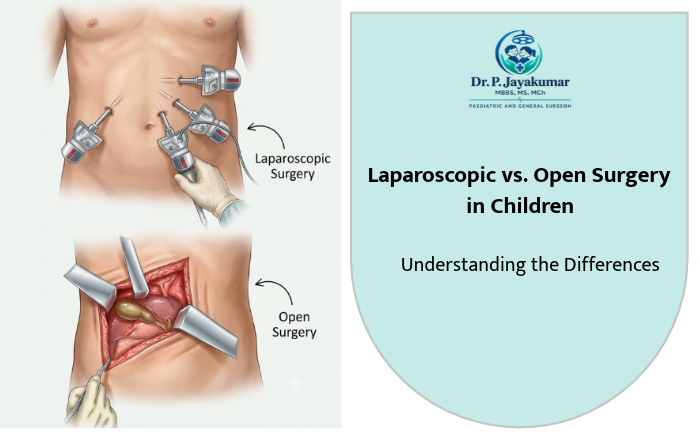
Laparoscopic surgery, also known as keyhole surgery or minimally invasive surgery, is a technique in which the surgeon performs an operation through small incisions rather than making one larger cut.
During the procedure, a thin instrument called a laparoscope, fitted with a small camera and light, is inserted through one of the incisions. It allows the surgeon to view the internal organs on a monitor.
Other specialised surgical instruments are inserted through additional small openings to perform the required operation.
In many procedures, the abdomen is gently filled with carbon dioxide gas to create enough space for the surgeon to work and see the internal structures.
Common Conditions Treated with Laparoscopic Surgery
Laparoscopic techniques may be used for several paediatric conditions, depending on the child’s age, health and specific diagnosis.
Some examples include:
- Appendicitis: Removal of an inflamed appendix through laparoscopic appendectomy.
- Inguinal hernia: Repair of certain groin hernias using a laparoscopic approach.
- Undescended testis: Assessment and treatment of selected cases where the testis is located inside the abdomen.
- Gallbladder conditions: Removal of the gallbladder in children with certain gallbladder problems.
- Ovarian cysts: Evaluation and treatment of selected ovarian cysts.
- Abdominal conditions: Diagnosis and treatment of certain conditions affecting the abdominal organs.
Not every child with these conditions will require laparoscopic surgery. The decision depends on the individual case.
What Is Open Surgery in Children?
Open surgery is a traditional surgical approach in which the surgeon makes an incision to directly access the affected organ or body part.
The size and location of the incision depend on the type of operation and the area being treated.
Unlike laparoscopic surgery, open surgery does not require a camera to view the surgical area. The surgeon works directly through the incision to examine and treat the affected structures.
Open surgery remains an important part of paediatric surgical care. It is particularly useful when a condition requires direct access, a larger surgical field or a specific type of repair.
Common Conditions Treated with Open Surgery
Open surgical procedures may be recommended for:
- Certain complicated cases of appendicitis.
- Complex abdominal conditions.
- Intestinal obstruction or severe bowel problems.
- Selected cases of hernia repair.
- Certain congenital abnormalities.
- Conditions requiring extensive surgical correction.
- Situations where laparoscopic surgery is not suitable or cannot be safely completed.
In some cases, a procedure that begins laparoscopically may need to be converted into open surgery if the surgeon finds that continuing with the minimally invasive approach would not be appropriate.
This is a surgical decision made with the child’s safety as the priority.
Laparoscopic vs. Open Surgery in Children: Key Differences
Both approaches aim to treat the underlying medical condition. However, the techniques and recovery experiences can differ.
Here are the main differences parents should understand.
| Factor | Laparoscopic Surgery | Open Surgery |
|---|---|---|
| Incision size | Usually involves a few small incisions | Usually involves one larger incision |
| Surgical view | Uses a camera and monitor | Provides direct visual access |
| Surgical instruments | Uses specialised long instruments | Uses conventional surgical instruments |
| Postoperative pain | May involve less wound-related pain in suitable procedures | May involve more pain around the incision |
| Hospital stay | May be shorter for certain procedures | May be longer depending on the operation |
| Recovery | May allow an earlier return to normal activities | Recovery may take longer in some cases |
| Scarring | Usually results in smaller scars | May result in a larger scar |
| Suitability | Depends on the condition and surgical complexity | Suitable for many conditions, including complex cases |
It is important to understand that these are general differences. Actual outcomes depend on the procedure, the child’s health, the surgeon’s assessment and whether complications are present.
Advantages of Laparoscopic Surgery in Children
Laparoscopic surgery offers several potential benefits when it is appropriate for a child’s condition.
1. Smaller Incisions
One of the main differences is the size of the surgical cuts. Laparoscopic procedures generally require a few small incisions instead of one larger opening.
This may result in smaller visible scars after healing.
2. Less Wound-Related Pain
Since the incisions are generally smaller, some children may experience less pain around the surgical wound compared with open surgery.
However, pain also depends on the internal procedure performed and individual pain sensitivity.
3. Potentially Faster Recovery
Children undergoing certain laparoscopic procedures may be able to resume their normal activities sooner.
The actual recovery period depends on the type of surgery, the child’s age and overall health.
4. Shorter Hospital Stay in Some Cases
For selected operations, laparoscopic surgery may allow children to return home earlier.
However, not every laparoscopic procedure results in a shorter hospital stay. The child’s condition and postoperative progress remain important factors.
Advantages of Open Surgery in Children
Although laparoscopic surgery is increasingly used in paediatric care, open surgery continues to have an important role.
1. Direct Access to the Affected Area
Open surgery allows the surgeon to directly examine the affected organ and surrounding structures.
This can be useful when the condition requires extensive examination or repair.
2. Suitable for Complex Conditions
Certain complicated or advanced conditions may be better managed through an open approach.
For example, severe abdominal infections, extensive intestinal problems or complex congenital abnormalities may require direct surgical access.
3. Does Not Require Specialised Laparoscopic Equipment
Open surgery does not depend on a laparoscopic camera system and specialised instruments.
This can be relevant in certain emergency situations or when laparoscopic facilities are unavailable.
4. Useful When Laparoscopic Surgery Is Not Appropriate
Some children may have medical conditions, previous surgical procedures or anatomical factors that make laparoscopic surgery unsuitable.
In such cases, open surgery may be the more appropriate option.
Is Laparoscopic Surgery Better Than Open Surgery for Children?
This is one of the most common questions parents ask. The answer is that neither approach is universally better.
Laparoscopic surgery may offer benefits such as smaller incisions and reduced wound-related discomfort in suitable cases. However, open surgery may provide better access for certain complex procedures.
The choice depends on several factors:
- Child’s age: The child’s age and body size may influence the surgical approach.
- Type of condition: Some conditions are more suitable for laparoscopic treatment, while others require open surgery.
- Severity of the problem: Complicated infections, bleeding or extensive tissue involvement may affect the decision.
- Previous surgeries: Previous abdominal operations may influence the choice of technique.
- Overall health: Existing medical conditions and the child’s general health are considered.
- Surgeon’s assessment: The surgeon evaluates which approach is appropriate based on the child’s individual needs.
Parents should discuss the expected benefits, risks and limitations of both approaches with the treating paediatric surgeon before making a decision.
What Should Parents Expect Before and After Surgery?
Preparing a child for surgery involves more than understanding the surgical technique. Parents also need to know what happens before and after the procedure.
Before Surgery
The surgical team may recommend:
- A physical examination and review of the child’s medical history.
- Blood tests, ultrasound or other investigations, if required.
- An assessment by the anaesthesia team.
- Instructions about when the child should stop eating and drinking.
- Guidance about regular medications, if applicable.
Parents should follow the hospital’s instructions carefully, particularly regarding fasting before anaesthesia.
After Surgery
Recovery depends on the procedure and the child’s condition. After surgery, the medical team monitors the child’s vital signs, pain levels and overall progress.
Parents may receive instructions regarding:
- Wound cleaning and dressing changes.
- Prescribed pain medication.
- Eating and drinking after surgery.
- Bathing and personal hygiene.
- Physical activity and return to school.
- Follow-up appointments.
Seek medical advice if the child develops fever, increasing abdominal pain, repeated vomiting, wound redness, swelling, discharge or any other concerning symptoms.
If the child experiences severe pain, difficulty breathing or appears seriously unwell, seek urgent medical attention.
How Can Parents Choose the Right Surgical Approach?
Parents do not need to decide between laparoscopic and open surgery based on incision size or recovery time alone.
The most important consideration is whether the procedure can safely and effectively treat the child’s condition.
Before surgery, consider discussing these questions with the paediatric surgeon:
- What is the exact diagnosis, and why does my child need surgery?
- Can the condition be treated through laparoscopic surgery?
- Why are you recommending laparoscopic or open surgery?
- What are the possible risks and complications?
- How long might my child need to stay in the hospital?
- When can my child return to school and normal activities?
- Is there a possibility that laparoscopic surgery may need to be converted into open surgery?
Having these discussions can help parents understand the treatment plan and prepare their child for the procedure.
Frequently Asked Questions
1. Is laparoscopic surgery safe for children?
Laparoscopic surgery is an established surgical technique used to treat several conditions in children. Like any operation, it carries potential risks. Its suitability depends on the child’s condition, age, health and the surgeon’s assessment.
2. Does laparoscopic surgery cause less pain than open surgery?
Laparoscopic surgery may cause less pain around the surgical wound because the incisions are smaller. However, internal discomfort and pain levels vary depending on the procedure and individual child.
3. How long does a child take to recover after laparoscopic surgery?
Recovery time varies depending on the operation. Some children return to normal activities within a few days, while others need several weeks. Parents should follow the surgeon’s instructions about activity restrictions.
4. Will my child have a scar after laparoscopic surgery?
Yes. Laparoscopic surgery involves small incisions, so small scars may remain after healing. Their appearance varies from child to child.
Conclusion
Laparoscopic and open surgery are both important approaches in paediatric surgical care. While laparoscopic surgery generally involves smaller incisions, open surgery provides direct access to the affected area and remains necessary for several complex conditions.
There is no single approach that is right for every child. The decision should be based on the diagnosis, the complexity of the condition, the child’s overall health and the surgeon’s clinical assessment.
Understanding these differences and discussing the available options with a qualified paediatric surgeon can help parents make informed decisions about their child’s surgical care.
About the Specialist
Dr. P. Jayakumar, MBBS, MS, MCh
Paediatric and General Surgery Specialist
Jayacharan Clinic, Namakkal
For consultations and appointments: 7812810044
Parents concerned about a child’s surgical condition can consult a qualified specialist to understand the diagnosis, available treatment options and the appropriate surgical approach.